The Complete AI Development Guide for Planning, Building and Launching AI in 2026
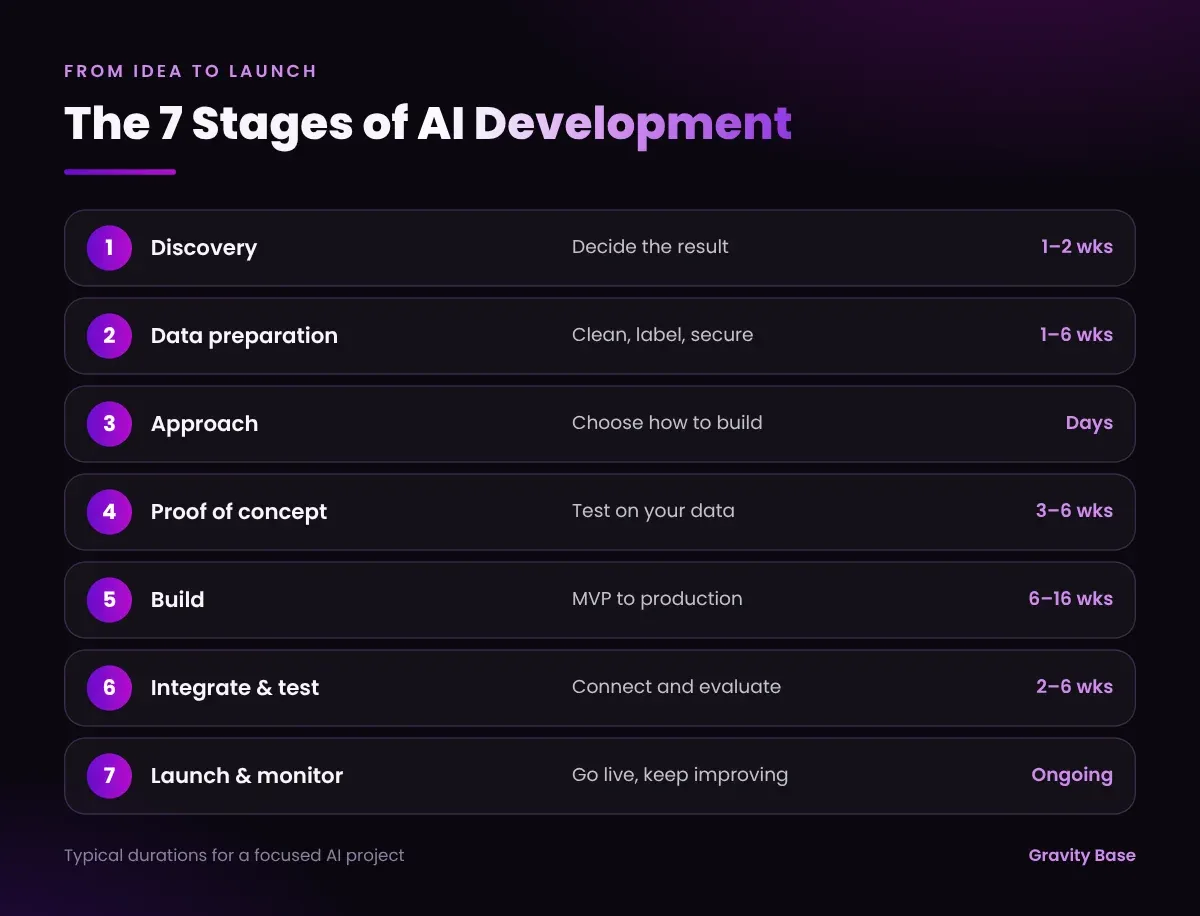
AI development is the work of turning a business problem into an AI system that does a real job, such as answering staff questions or running one step of a daily process. The work follows 7 stages:
1- First, define the outcome you want the AI system to deliver.
2- Next, prepare the data the system will learn from or read.
3- Then choose the model approach, which means deciding what kind of AI model will do the work.
4- Prove the idea with a proof of concept, which is a small test version that shows whether the idea works before you spend more money.
5- Build the product.
6- After that, test the product and connect it to the systems your business already uses.
7- Deploy the product, which means making it live for real users, then monitor it to catch problems.
AI projects come in 2 sizes, and each has its own timeline and cost:
I. A focused AI project: a single, limited system, such as a knowledge assistant that answers questions from your company documents or one automated workflow. For example, it typically takes 6 to 16 weeks to build and costs $15,000 to $150,000.
II. An enterprise AI platform: a larger system that many teams or departments use. By contrast, it typically takes 4 to 12 months to build and costs $100,000 to $500,000 or more.
What AI Development Means in 2026
In 2026, AI development mostly means taking an AI model that already exists and works, and connecting it to your company's data, software and daily work so it does one specific job well. A model is the part of an AI system that has learned from data, so it can answer questions, make predictions or recognise images. As a result, most projects don't need to train a new model from nothing.
In general, most projects fall into one of five types of AI system:
| Type of AI | What it does | Example |
|---|---|---|
| Generative AI | Creates new content from an instruction you give it | Drafting documents, creating images or videos |
| LLM apps | Reads and writes text in everyday language | An assistant that answers staff questions from company documents |
| AI agents | Plans a task with several steps, then completes it using your software | Updating customer records in your CRM |
| Predictive machine learning | Learns patterns in past data to predict an outcome | Scoring how likely a customer is to stop buying (churn) |
| Computer vision | Recognises what is in images and video | Checking products for defects or reading scanned documents |
However, many real systems combine two or more types of AI. For example, a support assistant might use an LLM to answer questions and an agent to issue refunds. The same assistant might also use a classifier to route urgent tickets to a person.
How an AI Development Project Moves From Idea to Launch
In short, every successful AI project goes through the same stages. Skipping one is the most common reason projects cost more than planned or never reach real users. In particular, the stages most often skipped are discovery (deciding what result you want) and evaluation (testing that the system works well enough).
| Stage | Its job | How long | What you get |
|---|---|---|---|
| 1. Discovery | Decide what result you want | 1 to 2 weeks | A clearly defined job for the AI |
| 2. Data preparation | Collect, clean, label and secure the data | 1 to 6 weeks | Data that is ready to use |
| 3. Approach selection | Choose how to build the system | A few days, within discovery | A build plan and cost estimate |
| 4. Proof of concept | Test the idea on a small scale | 3 to 6 weeks | Proof from your own data that it works |
| 5. Build (MVP to production) | Make the real product | 6 to 16 weeks | A product real users can start using |
| 6. Integration and evaluation | Connect the system to your software and test it | 2 to 6 weeks | Your software connected to a tested AI |
| 7. Launch and monitoring | Make the system live, then keep improving it | Ongoing | A live system with dashboards and an improvement plan |
1. Discovery – Decide What Result You Want
Start by deciding what business result you want, before you think about the technology. For example, "cut first-line support tickets (the first requests customers send to your support team) by 30%" is a good goal, because it is a result you can measure. In contrast, "use AI in customer service" is not, because it names the technology and not a result.
Discovery also checks whether your data, systems and team are ready for the project. If you're not sure, an AI readiness assessment, which is a short check of your data, systems and team, can answer that in a few hours.
2. Data Preparation – Get Your Data Ready
Next, data preparation means getting your data ready for the system to learn from. In fact, it often takes a quarter to a third of the total budget. You may need to:
- pull the data out of spreadsheets, PDFs or old systems
- remove duplicates
- label examples, which means marking them so the model knows what "good" looks like
Decide early between in-house or outsourced data labelling, because this choice affects both cost and timeline.
3. Approach Selection – Choose How to Build the System
Most of the project's cost is decided at this stage, because you are choosing how the system will be built. Later in this guide, we compare the four main approaches side by side.
4. Proof of Concept – Test the Idea on a Small Scale
Then a proof of concept (PoC) is a small test version of the system. It answers one question: can AI do this job well enough on your data?
So keep it small, and give it a time limit, usually 3 to 6 weeks. Before you start, agree what result counts as success, such as "answers 85% of test questions correctly". Then judge the PoC against that result.
5. Build – Make the Real Product
Next, the build turns the PoC into a product people can use every day. To do that, the product needs:
- a user interface (the screens people use)
- user accounts
- error handling (what the system does when something goes wrong)
- logging (a record of what the system does)
- security
Most teams release a minimum viable product (MVP) first. In other words, an MVP is the first version real users can rely on. Once people are using it, you then add the features they actually need.
6. Integration and Evaluation – Connect and Test the System
AI is only useful when it works inside the tools your team already uses. Integration is therefore the work of connecting the AI to those tools, such as your CRM (customer relationship management software), ERP (business management software), helpdesk or website.
Evaluation, on the other hand, is testing the system. Before every release, you test it on the same set of real examples and measure four things:
- accuracy, meaning how often the answers are correct
- hallucinations, meaning answers the AI makes up that are not true
- response time, meaning how long the system takes to answer
- cost per task, meaning what each job costs to run
7. Launch and Monitoring – Go Live, Then Keep Checking
After launch, an AI system keeps changing in three ways. First, users start asking different questions. Second, your data drifts, which means it slowly stops matching the data the system learned from. Finally, the companies that provide the AI models update them.
That's why you need to keep monitoring it. Monitoring tracks 3 things:
I. Accuracy: how often the answers are correct
II. Cost: what the system costs to run
III. Usage: how much people use it
When quality drops, monitoring triggers one of 2 fixes:
I. Retraining: teaching the system again with newer data
II. A prompt update: changing the instructions you give the system
These changes are also why running an AI system is different from running normal software. MLOps is the way teams run AI systems, whereas DevOps is the way teams run normal software. For more detail, our explainer on how MLOps differs from traditional DevOps covers the differences.
Choosing the Right AI Development Approach
The way you build your AI system decides most of its cost, timeline and risk. For this reason, the table lists four options, from the simplest to the most complex. As a rule, start with the simplest option that can meet your goal.
| Approach | What it is | When it fits | Cost | Time to first version |
|---|---|---|---|---|
| Ready-made AI tool | A product you pay for monthly | A ready-made product already does the task well | Lowest | Days |
| Existing model connected to your data (RAG) | A model that looks up your documents before it answers | The AI must answer from your documents or product data | Low | 3 to 8 weeks |
| Fine-tuned model | An existing model trained further for one narrow job | You need a tone, format or skill the model lacks | Medium | 6 to 12 weeks |
| Custom-trained model | A new model trained on your own data | You need predictions from your own data, or very specialised work | High | 2 to 6 months |
Which Approach Most Business Projects Use
In 2026, most business projects use the second approach in the table. In other words, they take a large language model, which is an AI model that reads and writes text, and connect it to the company's own data. As a result, this method is called retrieval-augmented generation (RAG).
Problems that need a prediction, however, work differently. For instance, examples are forecasting demand or spotting fraud. These still need machine learning solutions, which are models trained on your past data.
Finally, if no ready-made tool fits your process, your data or your security rules, custom AI solutions are usually the better choice in the long run.
The People You Need on an AI Development Project
An AI engineer alone cannot deliver an AI project, because the project needs six different jobs done. In practice, a small team that covers all six jobs usually does better than a large team that is missing some of them.
| Role | The job they do |
|---|---|
| Product owner | Owns the business goal, makes project decisions and approves results |
| AI or ML engineer | Designs the AI, writes prompts, sets up retrieval and builds agents |
| Data engineer | Pulls, cleans and moves data from your systems to the AI |
| Full-stack developer | Builds the screens and connects the AI to your systems |
| QA and evaluation | Builds test sets and checks accuracy, safety and cost before each release |
| Project manager | Keeps scope, budget and timeline under control |
How Much AI Development Costs in 2026
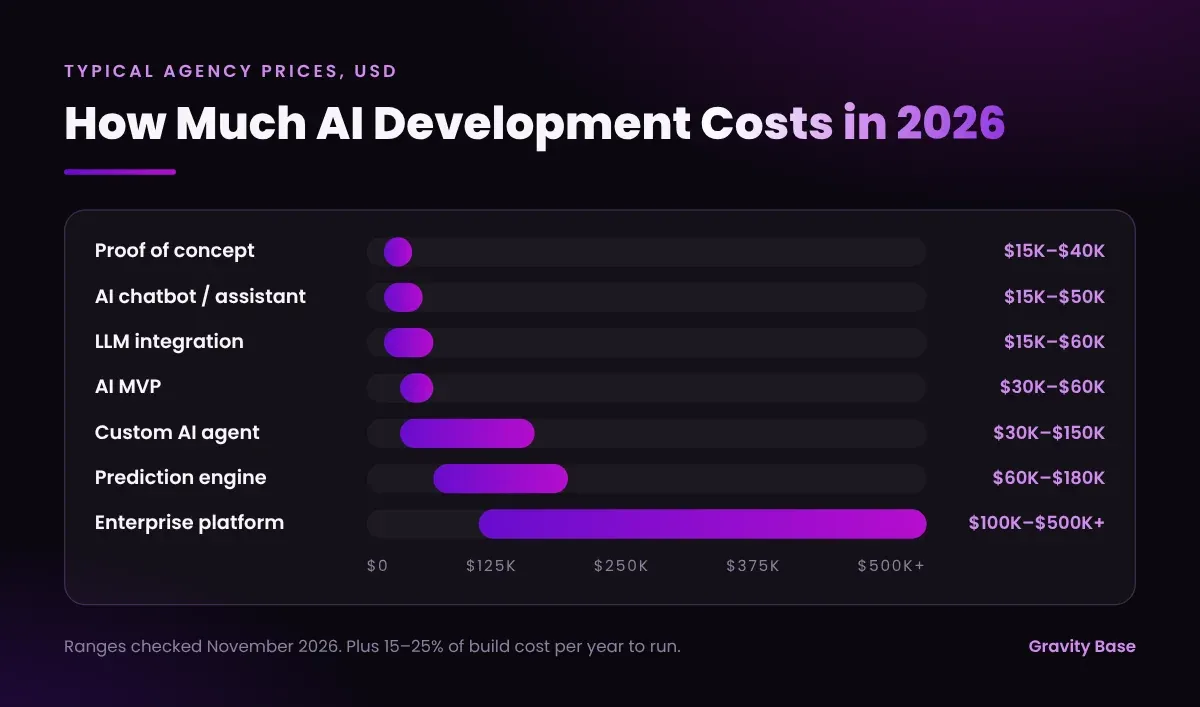
AI development costs from about $15,000 for a small proof of concept to $500,000 or more for an enterprise AI platform (a large system used across a whole company). The table shows typical 2026 prices when an agency, an outside company that builds AI for you, does the work.
| Project type | Typical cost (USD) | Typical timeline |
|---|---|---|
| Proof of concept | $15,000 to $40,000 | 3 to 6 weeks |
| AI chatbot or support assistant | $15,000 to $50,000 | 4 to 10 weeks |
| LLM integration into an existing product | $15,000 to $60,000 | 3 to 8 weeks |
| AI MVP (new product) | $30,000 to $60,000 | 8 to 12 weeks |
| Custom AI agent or workflow automation | $30,000 to $150,000 | 6 to 16 weeks |
| Recommendation or prediction engine | $60,000 to $180,000 | 3 to 6 months |
| Enterprise AI platform | $100,000 to $500,000+ | 4 to 12 months |
After launch, also plan to spend another 15% to 25% of the build cost every year to run and improve the system. Prices also vary a lot by market. For local figures, see how much AI development costs in the UK, the AI development cost in Saudi Arabia and the AI development cost in Dubai.
How Long AI Development Takes, and What Slows It Down
In general, how long a project takes depends on what you are building:
- A proof of concept takes 3 to 6 weeks.
- An MVP takes 8 to 12 weeks.
- A production system (a complete system running for real users) takes 3 to 6 months.
- An enterprise platform takes 4 to 12 months.
Meanwhile, 3 things slow projects down more than anything else:
1- Data that isn't ready: if data is missing, messy or something the team cannot access, it can add weeks before anyone starts building the AI.
2- No agreed standard: if nobody has agreed what "good enough" means, the team keeps changing and retesting the system, and never knows when to stop.
3- Slow decisions and slow access: waiting for API keys (the codes that let one piece of software use another), security reviews or sign-off often costs more time than the build itself.
Why AI Development Projects Fail, and How to Prevent Each Cause
The reasons AI projects fail are predictable, and so are the fixes. Therefore, the table pairs each reason with the step that prevents it.
| Why projects fail | How to prevent it |
|---|---|
| No clear business problem | Agree one measurable result before building |
| The data isn't ready | Check the data in discovery, and budget time to clean and label it |
| Nobody agreed what "good enough" means | Agree standards and a test set before the proof of concept |
| The test version works, but the full system can't grow | Build the proof of concept with real data and systems, not a demo |
| Costs keep growing after launch | Include model and hosting costs in the business case from day one |
| Nobody owns the system after launch | Name an owner and write a monitoring plan before go-live |
| People don't use the system | Build it inside the tools people already use, and train them |
How to Measure Whether Your AI Project Is Working
Judge an AI project the way you would judge any investment: by whether it delivers the result you agreed on in discovery. From the first week, therefore, track three numbers:
- Result: the business result the project is meant to deliver, such as support tickets resolved, hours saved or revenue the project helped bring in.
- Quality: how good the work is when the AI does it, measured by accuracy, error rate or customer satisfaction.
- Cost: what each task costs, including the AI model and the people who check the AI's work.
Check the result number during the first one to three months. If it hasn't moved by then, fix the problem or stop the project. After all, doing this is far cheaper than expanding a system that doesn't work.
Should You Build AI In-House or Work With a Partner?
In practice, most companies build their first AI system with a partner, which is an outside company that builds it for them. Once the system has proved it is worth the money, they then decide whether to hire their own team.
An experienced partner brings three things: a complete team, delivery methods that have already been tested, and lessons from earlier projects. On the other hand, an in-house team makes sense when AI is central to your product and you will keep building it for years.
When you compare partners, look for four things:
- Work that is already running for real users, not only demos
- A clear plan for protecting your data
- Ownership of the IP (intellectual property) set out in writing
- A monthly running-cost estimate in the proposal
Next, our guide to choosing an AI consulting partner covers the questions to ask. And if you're in the UK, our shortlist of the top AI development companies in London is a good place to start.
Which Data Protection Laws Apply to Your AI System
If your AI system uses personal data, it must follow the data protection law of the place where its users are.
- UK and EU: UK GDPR and EU GDPR apply. In addition, the EU AI Act sets extra duties for high-risk AI used in the EU. After the 2026 Digital Omnibus, most of those high-risk duties apply from 2 December 2027.
- UAE: the UAE Personal Data Protection Law (Federal Decree-Law No. 45 of 2021) applies, with separate data protection laws in the DIFC and ADGM free zones.
- Saudi Arabia: the Personal Data Protection Law (PDPL), enforced by SDAIA since 14 September 2024, restricts transfers of personal data outside the Kingdom.
- US: there's no single federal AI law yet, so sector rules such as HIPAA (health) and state privacy and AI laws apply.
How Gravity Base Helps With AI Development
Above all, Gravity Base is an AI development company that takes AI from idea to production, usually in 4 to 12 weeks for a first release. Every project starts with a scoping call, then a fixed-scope discovery, so you know the cost before the build begins.
We offer AI solutions that include:
- Assistants and chatbots: AI chatbot development services for websites, WhatsApp and internal knowledge bases.
- AI products: AI app development services for web and mobile apps with AI at the core.
- Predictive models: machine learning for forecasting, scoring and recommendations.
- Custom systems: agents, automations and integrations built around your data and rules.
In addition, we work with teams worldwide and have local teams for AI development in Dubai, as an AI development company in London, and as an AI development company in Saudi Arabia.
Planning an AI project? Book a scoping call, and we'll tell you which approach fits, what it will cost and how long it will take.
Finally, costs, timelines and laws were checked in November 2026.
Frequently Asked Questions
What is AI development?
AI development means building and running software that uses AI to do one specific job, such as answering questions, predicting demand or processing documents. Overall, it covers discovery, data preparation, choosing an approach, building, testing, launching and monitoring.
What are the steps in AI development?
Decide the result you want, prepare your data, choose how to build, test the idea with a proof of concept, build the product, connect and test it, then launch and monitor it. Most delays come from the first two steps.
How long does it take to develop an AI system?
A proof of concept takes 3 to 6 weeks, an MVP 8 to 12 weeks, a production system 3 to 6 months and an enterprise platform 4 to 12 months. The biggest factor is how ready your data is.
How much does AI development cost?
In 2026, a proof of concept costs $15,000 to $40,000, while an enterprise platform costs $100,000 to $500,000 or more. After launch, budget another 15% to 25% of the build cost every year.
Do I need to train my own AI model?
Not always. Most business projects connect an existing large language model to their own data, which is faster and cheaper. Training your own model makes sense for predictions from your own data or very specialised work.
What is the difference between a proof of concept and an MVP?
A proof of concept tests whether AI can do the job on your data, usually in 3 to 6 weeks. An MVP is the first version real users can rely on. In short, a PoC answers "can it work?", while an MVP answers "will people use it?".